

Check the car you’re looking at
Enter the VIN to decode it for free, with its open recalls. Then pick the reports you want, if any.
Letters and numbers, no I, O or Q. It decodes as soon as all 17 are in.
Try it with
Key takeaways
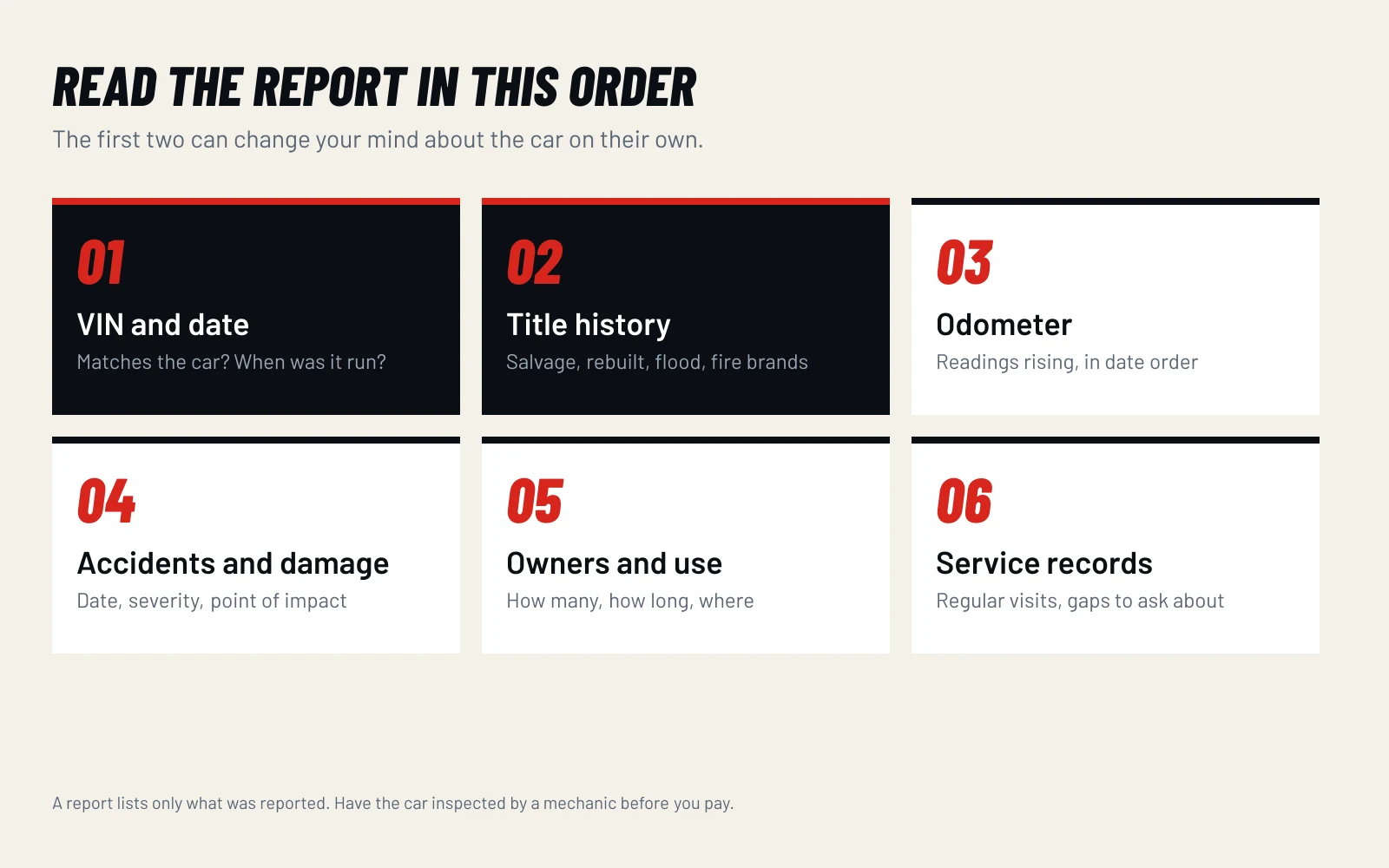
- Before reading anything else, check that the VIN on the report matches the car, and note the date the report was run.
- Read the title history first: a brand such as salvage, flood or fire changes what the car is worth and how hard it is to insure.
- Line up the odometer readings by date. Each should be higher than the last; a drop or years with almost no miles needs an explanation.
- “Damage reported” doesn’t mean the car was totaled, but structural damage (to the frame or unibody) calls for a structural inspection before you buy.
- A report only shows what was reported to CARFAX, and the FTC notes it usually won’t list mechanical problems. Have the car inspected whatever it says.
On this page
- Start with two checks: the VIN and the date
- Title history: read this before anything else
- Ownership history: who had the car, where and how long
- Odometer readings: put them in date order
- Accidents and damage: what the labels mean
- Service records: the quiet section that tells you most
- What a CARFAX report can’t tell you
- Turn what you read into questions
Start with two checks: the VIN and the date
Every CARFAX report is tied to one 17-character VIN. Before reading a single entry, compare the VIN at the top with the car itself: the dashboard by the windshield, the label in the driver’s door frame and the title. A report for the wrong VIN is worse than no report.
Then note the date the report was run. It shows the history up to that day only. If a seller hands you an old copy, anything since (a sale, an auction, a new title) won’t be on it. Our guide to the free CARFAX report explains how to judge a copy someone else ran.
Title history: read this before anything else
The title history follows the car’s title from owner to owner and flags branded titles, issued after events such as fire, flood or other serious damage. CARFAX calls it one of the most important parts of the report to check before you buy.
- Salvage or total loss: an insurer judged the repair not worth it. The car may have been rebuilt since; see salvage title check.
- Rebuilt or reconstructed: a salvage car that was repaired and passed a state inspection. Ask for the repair records.
- Flood or fire: damage that can surface long after the repair. Read our flood damage check.
- Several titles in different states in a short time: worth asking about. Moving a car between states can be used to try to drop a brand, which CARFAX calls title washing.
A clean title history isn’t proof on its own, but a brand is close to final: if you see one, price the car, the insurance and the resale as a branded car. Our guide to CARFAX title brands lists them one by one.
Ownership history: who had the car, where and how long
This section shows when each owner bought the car, how long they kept it, where it was registered and roughly how many miles it was driven each year. Read it as a story rather than a score:
- Number of owners. More owners isn’t bad on its own. A string of short ownerships, a few months each, is the pattern to ask about.
- How the car was used. Personal, lease, rental or fleet use shapes how it was driven and maintained. None is a deal-breaker; each is a question.
- Where it was registered. Coastal, flood-prone or snowy regions are a reason to look harder for rust and water damage.
- Miles per year. Compare the estimate with the odometer. A car that drove a lot and then almost nothing may have sat, or the readings may be off.
Odometer readings: put them in date order
CARFAX lists the mileage recorded at each event: registrations, inspections, services, sales. It suggests comparing those readings with the title, maintenance and inspection records. Each reading should be higher than the one before, by an amount that fits the time between them.
| What you see | What it may mean | What to do |
|---|---|---|
| A reading lower than an earlier one | A typo in a record, a replaced instrument cluster, or a rollback | Ask for paperwork; have the cluster checked |
| Years with almost no new miles | The car sat, or records are missing | Ask where it was and why |
| Today’s odometer below the last reading | A serious warning sign | Walk away unless it’s explained in writing |
| Readings that fit the dates and the service visits | A consistent history | Still compare the dashboard with the last entry |
Accidents and damage: what the labels mean
When CARFAX receives a record of damage, the report shows the event with its date and, when the source reported it, how severe the damage was and where the car was hit. CARFAX notes that states report different amounts of information after a crash, and that older crashes often come with less detail.
Is “damage reported” bad?
Not necessarily. It means some damage was reported for the car, and not all of it comes from crashes: CARFAX gives examples such as backing into a pole or a branch falling on the car. “Damage reported” on its own doesn’t mean the car was totaled. Read the date, the severity and the point of impact, then ask the seller what was repaired and where.
Minor, moderate and severe
CARFAX’s glossary sorts damage into levels. Minor damage is generally cosmetic, such as dents and scratches, and typically doesn’t affect how the car works or how safe it is. Moderate damage can affect several parts and how the car works; severe damage more so. The exact wording can differ from one report to another; some reports call moderate damage that may affect how the car works “functional damage”.
What does structural damage mean on CARFAX?
CARFAX defines structural damage as damage to the main structure of the car, or to any part designed to give it structural integrity: the frame or the unibody. A crash of any severity can cause it. It often doesn’t mean the car was totaled, because the structure can often be repaired, but CARFAX recommends a structural inspection before you buy.
Service records: the quiet section that tells you most
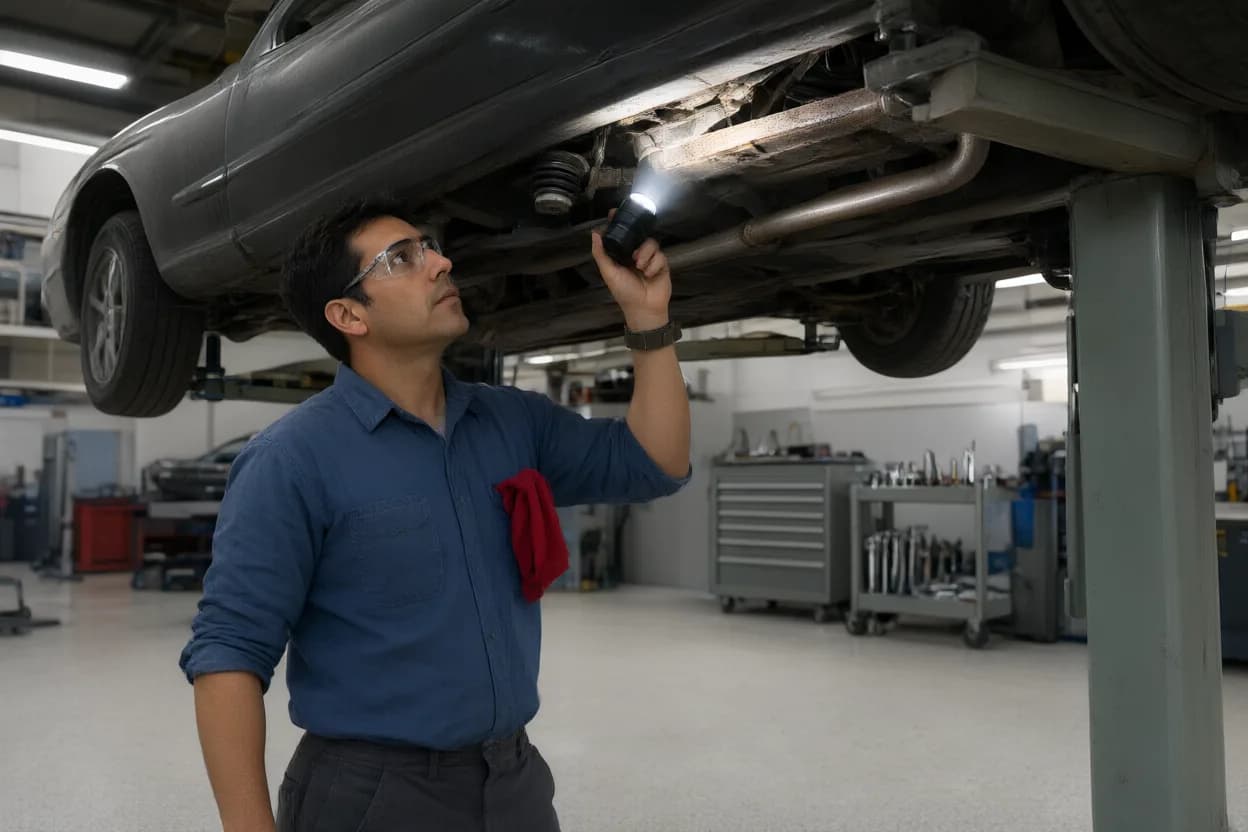
Service visits reported to CARFAX show what was done and when, with the mileage at each visit. CARFAX points out that they also help confirm the odometer. Look for regular oil changes and scheduled maintenance; a long gap isn’t proof of neglect (plenty of independent shops don’t report), but it’s a question for the seller: ask for receipts.
Repairs listed right after a damage event are useful too: they show where the car was fixed. A big repair with no damage event before it is worth asking about.
What a CARFAX report can’t tell you
- Anything that wasn’t reported to CARFAX: CARFAX itself notes that other information, including problems, may not have been reported.
- Mechanical condition: the FTC notes that history reports usually don’t list mechanical problems.
- How well a repair was done, even when the repair appears on the report.
- Anything after the date the report was run.
The FTC suggests a second report from a different company, since the records in any one may be incomplete. AutoCheck is stronger on auction records; see CARFAX vs AutoCheck.
Turn what you read into questions
The report’s real value is the questions it gives you. Before you see the car, write down one question for each thing that surprised you:
- For the seller: “The report shows damage to the front in [year]. Where was it repaired, and do you have the invoice?”
- For the seller: “There are two years without service records. Do you have receipts from another shop?”
- For the mechanic: “The report lists structural damage. Please check the frame and the panel gaps.”
- For the mechanic: “The car was registered in a flood-prone area. Please look for water damage and corrosion.”
- For yourself: if the title is branded, price the insurance and the resale before you negotiate.
Then have the car inspected by a mechanic you choose. The FTC advises an independent inspection even for a car a dealer has certified, and suggests going elsewhere if a dealer won’t allow one.
Questions
What should I look at first on a CARFAX report?
The VIN and the date the report was run, then the title history. A wrong VIN or a branded title changes everything else you read.
What does structural damage mean on CARFAX?
Damage to the car’s main structure, the frame or unibody, or to parts that give it structural integrity. It can often be repaired, but CARFAX recommends a structural inspection before you buy.
Is “damage reported” on CARFAX bad?
Not on its own. It means some damage was reported, not that the car was totaled. Check the date, the severity and where the car was hit, and ask how it was repaired.
What does functional damage mean on a CARFAX report?
Some reports use it for moderate damage that may affect how the car or its parts work. The wording varies between reports; read it with the severity and the point of impact.
How many owners is too many?
There’s no fixed number. Several long ownerships are normal; a string of owners who each kept the car a few months is the pattern worth asking about.
Can a CARFAX report be wrong?
It can miss things, because it only lists what was reported to CARFAX. That’s why an inspection matters, and why a second report from another company can help.
Where can I get a CARFAX report for less?
Here a CARFAX report costs $8.99 instead of $44.99 on carfax.com. It’s the same report, delivered to your account and by email.
Was this helpful?

About the author
Tayron Bram
Data Validation Officer
Tayron Bram is the Data Validation Officer at Smart VIN Check, with 41 years of experience in used-car sales, auto auctions and vehicle data. Tayron has checked thousands of vehicle history reports and worked with dealers importing cars from the US. At Smart VIN Check, Tayron checks that every fact in our guides matches its source, from state title rules to NMVTIS and NHTSA records, and goes back to those sources when they change. Before a guide is published, Tayron reads it the way a buyer would, looking for anything unclear, out of date or not backed by a source. Tayron also keeps the prices we quote from other sellers current, so the comparisons on our pages stay accurate.
More from Tayron BramRelated
- CARFAX report by VIN: how to get one and what it showsRead the guide
- Free CARFAX report: what you can really get for freeRead the guide
- Title brands in a history report, explainedRead the guide
- Odometer rollback check by VINRead the guide
- Accident history check by VINRead the guide
- CARFAX vs AutoCheckRead the guide
Sources
- What’s on a CARFAX report and how can it help me? (CARFAX help center)checked October 2026
- How to read a CARFAX report (carfax.com)checked October 2026
- How to read accident information on a CARFAX report (carfax.com)checked October 2026
- Car frame damage and other structural damage (carfax.com)checked October 2026
- CARFAX glossary (carfax.com)checked October 2026
- What is title washing? (carfax.com)checked October 2026
- Buying a used car from a dealer: FTC consumer advicechecked October 2026