Free VIN decoder
Paste or type a VIN and it decodes by itself: year, make, model, engine and where the car was built, from the U.S. government’s vehicle database, plus open safety recalls.
Letters and numbers, no I, O or Q. It decodes as soon as all 17 are in.
Try it with
What a VIN decode tells you
The 17-character VIN encodes who built the car, the model year, the plant and a serial number. Decoding it confirms the listing describes the right car: the right year, engine and trim.
It doesn’t tell you the car’s history. For accidents, title brands and odometer readings you need a history report.
How to decode a VIN
- 01
Find the VIN
It’s on the dashboard where it meets the windshield, on the driver’s door frame, and on the title and registration.
- 02
Paste, type or scan it
Enter the 17 characters, or scan them with your phone’s camera. The decoder starts by itself when all 17 are in.
- 03
Compare the decode with the car
Check the year, model, engine and plant against the listing and the paperwork. A mismatch is a reason to ask questions.
- 04
Check what happened to it
If everything matches, a history report shows title brands, accidents and odometer readings the decode can’t.
Where to find the VIN
- Dashboard
- Look through the windshield at the driver’s side, where the dashboard meets the glass.
- Driver’s door frame
- Open the driver’s door: the VIN is on the label on the door edge or the pillar.
- Title and registration
- The VIN is printed on the title, the registration card and most insurance cards.
- Your history report
- Every report starts with the VIN it was run on. Check it matches the car before you read further.
What each part of a VIN means
Since 1981, cars sold in the US carry a 17-character VIN in a fixed format. Each position has a job:
| Positions | What they tell you |
|---|---|
| 1–3 | Who built the vehicle and in which region: the world manufacturer identifier (WMI). |
| 4–8 | The vehicle’s attributes as the manufacturer codes them: model line, body, engine, restraints. |
| 9 | The check digit, a calculation that catches mistyped or altered VINs. |
| 10 | The model year. |
| 11 | The assembly plant. |
| 12–17 | The vehicle’s serial number. |
More detail: What is a VIN?, the model year chart and the VIN structure under ISO 3779.
A free decode or a history report?
The decode tells you what the car is. A history report tells you what happened to it.
| Free VIN decode | History report | |
|---|---|---|
| Year, make, model and engine | Yes | Yes |
| Plant and factory equipment | Yes | Some reports |
| Open safety recalls | Yes, from NHTSA | Some reports |
| Title brands: salvage, flood, rebuilt | No | Yes |
| Accidents and damage | No | Yes |
| Odometer readings over time | No | Yes |
| Owners and auction sales | No | Yes |
What a decode can’t tell you
Two cars of the same model decode the same way. The VIN describes the car as it left the factory, not what happened since.
A crash, a flood, a salvage title or a rolled-back odometer leaves no trace in the decode. Those come from records filed after the sale, which is what a history report collects.
Decode by brand
How each carmaker writes its VINs: its manufacturer codes, what it puts in the descriptor section, and where to check its recalls.
Free for Chrome
Check the VIN without leaving the listing
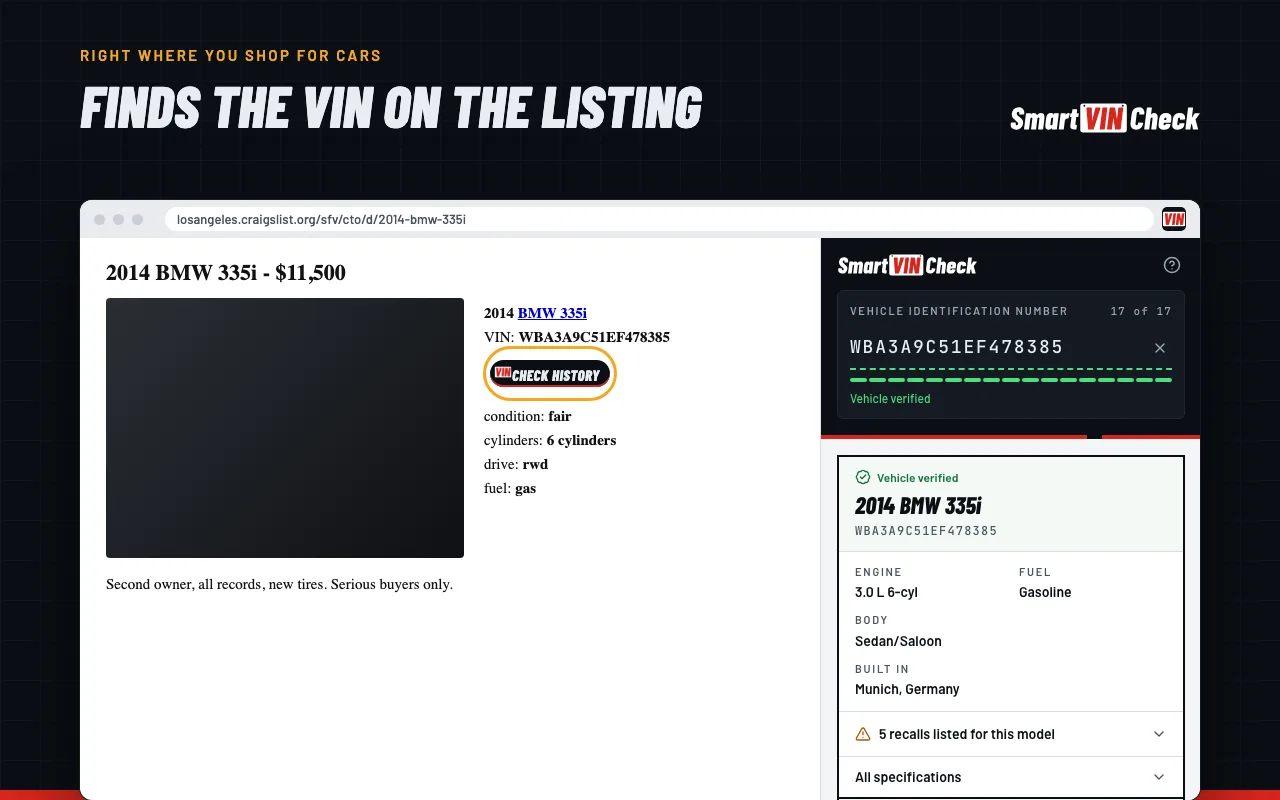
Our free Chrome extension finds the VIN on Facebook Marketplace, Craigslist, AutoTrader, Copart and other listing sites, decodes it with the open recalls, and opens the history reports for that car in one click.
Only have a license plate?
Our plate search finds the VIN for a US plate and decodes it the same way. It shows the vehicle, never the owner.
VIN decoder questions
Is this VIN decoder free?
Yes. There’s no account and no limit for normal use. The data comes from NHTSA’s free vPIC service and recall database.
What does a VIN decoder tell me?
The model year, make, model, trim, body, engine, drive type, transmission, plant and safety equipment as the manufacturer reported them, plus recalls NHTSA lists for that model.
Is a VIN decode the same as a vehicle history report?
No. A decode describes the car as built. A history report adds what happened later: title brands, accidents, owners, odometer readings and auction sales.
Why won’t my VIN decode?
Usually a typo: VINs never use the letters I, O or Q, and North American VINs must pass the check digit. Cars built before 1981 have shorter VINs that this decoder doesn’t read.
Does it work for cars from outside the US?
It works best for vehicles built for North America from 1981 on. Others may decode only partly, from the VIN’s own structure.
What is the check digit?
Position 9 of a North American VIN is calculated from the other 16 characters. If it doesn’t match, the VIN was mistyped or altered.
Can I find the owner from a VIN?
No. Owner records are protected by the federal Driver’s Privacy Protection Act. We never show who owns or owned a car.
Where do the recall results come from?
From NHTSA’s recall database, for the decoded year, make and model. Ask a dealer for the brand whether this exact car’s recall repairs were done; recall repairs are free.
Importing a US car?
Decode the VIN first, then check our country guides for the rules where the car is going.
Import guides by countryDecoding uses NHTSA’s vPIC service and recalls come from NHTSA’s recall database. The VIN’s structure is set by federal rule 49 CFR Part 565.